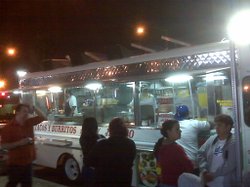
 Despite all the idiocy in this new LA County law restricting taco trucks, The Associated Press reports that the law may not be enforced very strongly and many taco truckers would continue to serve their tacos as they have been for years in a bout of carnitas-fueled civil disobedience.
AP:
Several taco truckers said they would simply ignore it, and a spokesman for the Los Angeles County Sheriff’s Department indicated deputies wouldn’t exactly be racing to enforce it.
In addition to fines, violators could be jailed for up to six months if they don’t move their truck within an hour of parking it. Under the old law, they had to move every 30 minutes, but few did because the penalty was only $60.
In heavily Hispanic East Los Angeles, where eating carnitas, quesadillas, cemitas and other Latin-flavored delicacies purchased from a lunch wagon is practically a rite of passage, people were as hot about the issue as a plate of carne asada.
“What? That’s terrible! That’s terrible!” shouted Roy Mendoza, upon learning that the Tacos El Galuzo truck he and his family have been patronizing for years might have to start hopscotching around town.
. . .
In fact, Mendoza said, the truck is cleaner, serves better food and at about half the price than many of the nearby restaurants he’s been in.
“It’s not about the restaurants. It’s about the food. We go where the food is good,” he said.
When the law was adopted on April 15, local business people said it was about the competition restaurants faced from truckers. Restaurateurs had complained for years that with little overhead costs, the truckers were eating their lunch.
“Look around, what do you think? They take away a lot of my business,” said Hor Lee, gesturing to her empty restaurant’s seating area. She has operated the Chinatown Express in a strip mall just a half-mile down the street from Torres’ truck for 11 years. Business was fine until about a year ago, she said, when two other trucks moved just around the corner from her.
“My rent is almost $5,000 a month,” she said. “We pay for electricity. We pay for workers. We pay a lot of bills. I think the taco trucks pay maybe only one bill, for a permit. It’s not fair.”
But Torres, who also wasn’t moving his vehicle, said he has far more costs than the average person realizes, starting with the $65,000 he paid for his truck. He also must pay to insure it, pay for a business license and a Health Department permit, and pay a local commissary for overnight parking.
Then there are food and employee costs and the rent he pays to the stereo store so his customers can use its parking lot.
On Wednesday night, he was a man in perpetual motion, fueling the generator that powers his stove, unloading cases of soda and water, and helping his son take orders in Spanish and English. Meanwhile, two employees grilled up huge portions of pork and beef as a steady flow of customers surrounded him.
Sheriff’s spokesman Steve Whitmore said Thursday that deputies “certainly will enforce the law, but whether or not this will be a priority may be another question.”
Share on Facebook
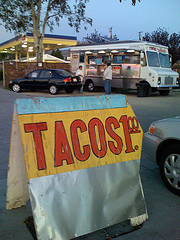

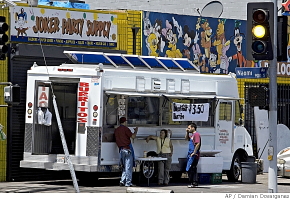 Kudos to The Associated Press for being the first nationwide news organization to cover the first ticketing of LA County taco trucks.
  Tweet This Post
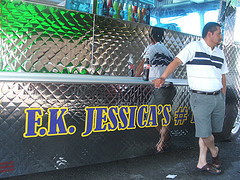 I did my own mini taco crawl in
  Amigos, our taco trucks are being attacked once again, but this time in North Carolina.
  My friends, taco trucks are not just under attack in Los Angeles, but also in Taft, Calif., just outside Bakersfield.
 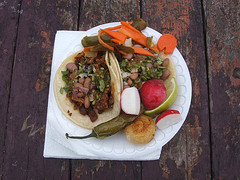 Vallejo’s Times-Herald is getting on the bandwagon, providing some positive taco truck news for once. Apparently the paper has just discovered that Vallejo’s got great taco trucks of its own.
 Just to be clear, when referring to the relevant portions of the California Vehicle Code and the Los Angeles County Code applicable to taco trucks, here is the actual text of the law:
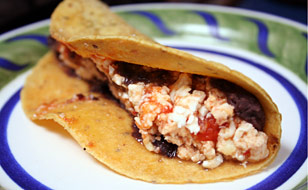 An Aussie who used to live in LA is informing his countrymen Down Under about this culinary travesty that is going on across the Pacific.