Archive for the ‘Legal’ Category

Lodi may cap number of local taco trucks

Posted by Cyrus Farivar on November 9, 2009

Despite creating a new permitting system for Lodi’s taco trucks last year, city officials are now looking to cap the number of taco trucks allowed to operate within the city limits.

According to the Lodi News-Sentinel:

In 2008, there were 16 taco trucks permitted by the city, and in 2009, there were 22. Before 2008, the city didn’t require a mobile food vendor permit for the vendors.

The city started requiring permits after several council members expressed concern about whether mobile food vendors had the correct health permits and business licenses, said Joseph Wood, neighborhood services manager.

There’s the usual points brought up about taco trucks being “unfair competition” to established brick-and-mortar restaurants.

However, the City of Lodi may want to consult this part of the article before making any ruling, which to me, shows how much taco trucks want to work with city officials to keep themselves in business:

The community development department has heard very few complaints about the taco trucks, including the ones near residential areas, Wood said. With the new permitting process, the department performs spot checks to see if there are any problems with the trucks.

One of the problems Wood spotted was a taco truck had a non-approved water connection because it didn’t have a hose that met state health requirements. The taco truck owner removed the hose, Wood said.

Another had an electric connection crossing a roadway or pedestrian area. While taco trucks can have electric connections, they cannot cross property where people are driving or walking, so the truck had to remove it.

I wonder what local attorney David LeBeouf has to say about this.

Santa Monica resists nouveau food trucks

Posted by Cyrus Farivar on October 30, 2009

Nope, it’s not just oppressive Los Angeles that wants to fight the newest, twittering generation of taco and food trucks. Sadly, it’s my hometown, Santa Monica.

This coastal outpost of liberalism is upset about these new trucks, as big business on the Third Street Promenade — or rather, the businesses parent association, the Bayside District Corporation — says that the trucks should have to pay to do business in this high foot-traffic area. At the corporation’s October 22 meeting, boardmembers were regaled with a presentation by the local police department on “Food Vending Truck ordinances and enforcement options.”

If the title alone didn’t suggest that there was much warm-and-fuzziness between the likes of Bayside and trucks like Nom Nom, the Santa Monica Daily Press provided an account that wasn’t exactly encouraging, either.

“I think if these people benefit from the Bayside District, they should have to pay for it,” said Barbara Bryan, a board member who owns the Interactive Cafe on Broadway, in an interview with the paper.

Of course, as the paper notes, all the trucks that operate in Santa Monica must have a vendor permit from the local police department and a business license from the city to operate legally. City ordinance allows them to conduct business in a parking spot, but they must move 100 feet every 30 minutes. Further, they have to be at least “10 feet away from the entrance, doors, vestibules, driveways and outdoor dining areas of any business,” according to the newspaper.

Gary Gordon, the executive director of the nearby Main Street Business Improvement Association, was a bit more blunt in his statement to the paper: “We would like to get rid of them.”

Hoo boy, this will sure get interesting.

Red Bluff to review first new proposed taco truck

Posted by Cyrus Farivar on October 27, 2009

According to the Red Bluff Daily News, this northern California town of 13,000 people is finally allowing its first new taco truck since the town banned them nearly a decade ago.

As we reported earlier this year, the town has not allowed any taco trucks since 2000, except for one that was grandfathered in.

This afternoon, the Red Bluff Planning Commission will meet today to consider the first new application since the May decision allowing for new trucks under certain conditions, like not being parked in parking spaces, being at least 12 feet from buildings and property lines, having at least two off-street parking spaces, not operating on private property, and not being closer than 300 feet from another vendor, among other requirements.

Carmen Gutierrez is applying for the as-yet-unnamed truck at 8 Sutter St., next to the Valero gas station. She has proposed an 8 am to 8 pm Monday-Saturday operating schedule and has received permission from the gas station to operate.

The meeting will take place at the Red Bluff City Council chambers at 555 Washington Street in Red Bluff at 5:15 pm this afternoon.

Update: The Red Bluff Planning Commission recommended the truck to the City Council, which will take up the matter at a forthcoming meeting.

Yuba City, Calif. to take up taco truck, mobile food regulations

Posted by Cyrus Farivar on October 20, 2009

Yuba City, Calif., is becoming the latest in a series of central California cities taking up the issue of regulation of mobile vending, reports the local county paper, the Appeal-Democrat. As the seat of Sutter County, it sits about 43 miles due north from Sacramento.

The local city council will take up the issue of mobile vending as it pertains to stands, taco trucks and other types of food trucks at the meeting tonight.

For the last few months, mobile vendors, established brick and mortar restaurants and others have met and will present the city council with their findings. The city council, in turn, is expected to give its recommendations for a new city ordinance.

This issue came about this summer when Fat Daddy’s Frankfurters began serving in front of Has Beans Café, which apparently cut into the café’s business.

As the paper reports:

Paul Kaiser, owner of Fat Daddy’s, understands concerns related to mobile vendors, but when cities govern and manage too much, it stifles free enterprise, he said.

If the council enacts an ordinance based on discussions he’s been a part of, mobile vending may not be allowed on public property, Kaiser said. Vendors would need permission from a private property owner and must get approval from similar businesses in a certain radius.

“If McDonald’s wants to open across from Carl’s Jr., they don’t go over to Carl’s Jr. and ask them if it’s all right,” Kaiser said. “Any rational person knows nine times out of 10 nobody is going to say ‘Yeah, come and open up.’”

If the city takes that approach, any new restaurant should have to ask for nearby vendors’ approval, he said.

“If it’s going to be good for the goose, make it good for the gander,” he said.

I’m not currently sure how many taco trucks are operating in Yuba City, but there’s at least one that hits a local high school at lunchtime.

The city council agenda devotes six pages to the issue in a memo drafted by Aaron Busch, the community development director. He describes that a series of three meetings were held by three street vendors and three brick-and-mortars as a means to advise the city on mobile vending.

According to the memo, city ordinances do not define mobile vending very well, as it does not distinguish between public/private vending, nor does it distinguish the various types of vending possible.

This group agreed that carts and “food wagons” (taco trucks) should have to move 400-1,000 feet every 30 minutes, but will not be required to have a planning department permit.

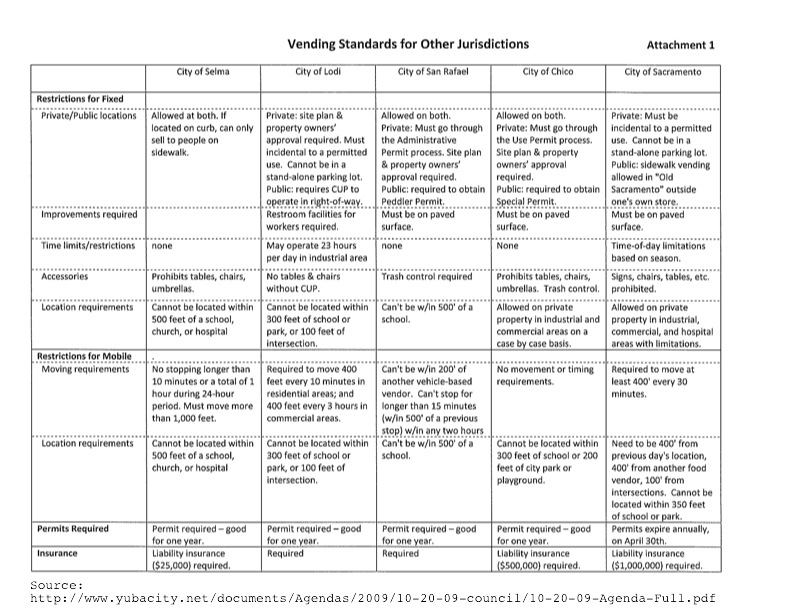
Interestingly, the agenda also contains the first comparative table of mobile vending in Northern California that I’ve ever seen. I’ve reproduced it here (click for a larger version):

We’ll see how this one plays out.

Starting early next month, there will now be a 500-foot rule (that’s about 1.5 city blocks) on vending by taco trucks, ice cream trucks and any other form of catering or vending in unincorporated areas of Sonoma County.

That’s thanks to a new rule passed last week by the county Board of Supervisors adds a new section to the Sonoma County Code.

The county’s own Summary Report states:

On March 19, 2009, at a meeting of the Joint City and County Roseland Subcommittee, during the public comment period, representatives of the Roseland School District and parents of children attending schools in the District, asked for assistance in regulating mobile vendors around school sites. A number of concerns related to the mobile vendors were expressed. They include:
– Sale of unhealthy and unregulated food products raising concerns about health and food safety;
– Potential sale of other products not legal for sale to minors (cigarettes, alcohol and other drugs, etc.);
– Unsafe conditions resulting from children darting in and out of cars and crossing streets to reach mobile
vendors; and
– Conduct of some of the mobile vendors raising concerns that school children might be subject to
inappropriate verbal comments and other forms of harassment.
The City of Santa Rosa has an ordinance restricting mobile vending. The County does not have such an
ordinance thus has no way to regulate mobile vendors around school sites in the unincorporated area.

Now I’m not really sure of any instances of “inappropriate verbal comments” given by any taquero to myself or anyone I’ve ever been with at any taco truck, but ok, fine.

This new ordinance is not unlike a measure earlier this summer that forced El Tonayense in San Francisco’s Potrero Hill neighborhood to move to at least 1,500 feet from schools.

LA taco truck attorney Phil Greenwald also reminds me in an email:

Los Angeles has a 1,000 foot restriction regarding how close to a school a catering truck may be lawfully parked.

Since no one wants to jeopardize the health or safety of school children and since kids have been known to forget that crossing a street (when they are focused on getting to a food vehicle) is a dangerous thing, I personally am in favor of such a restriction. 500 feet is (on average) about 1.5 blocks. That seems reasonable to me, don’t you think so?

Meanwhile, Erin Glenn, CEO of the new Asociación de Loncheros, says that there may be other factors at play here:

This type of problem was allegedly one of the reasons the Los Angeles County Board of Supervisors wanted there to be more stringent regulation of catering food trucks. In terms of operating near a school during school hours– this type of regulation actually makes sense, if a proper assessment of the situation i.e., traffic studies, etc. has occurred; hopefully, the Sonoma County regulation is motivated by the need for greater child safety, not by the need to “protect” brick and mortar establishments that may be near the schools in question. After all, let’s not forget that children need to cross the street to go into a convenience store as well.

About the food that may be sold from catering food trucks near schools: I would bet pound for pound, unless there are extraneous circumstances proving otherwise, the food one would get at a traditional taco truck is much healthier than typical fast food.

If taco trucks don’t comply, the ordinance also states the penalty:

Any person violating or causing the violation of the provisions of this section shall be guilty of a misdemeanor. Except where other penalties are specified, each offense may be punished by a fine of not less than one hundred dollars ($100.00) nor more than five hundred dollars ($500.00), or by imprisonment in the county jail for a term not to exceed sixty (60) days, or by both such fine and imprisonment.

SFWeekly’s John Birdsall (see our interview with him from February 2009 here) blogs that last Friday, the San Francisco Recreation and Parks Department modified its solicitation for proposals to include Golden Gate Park. Previously, the solicitation had included all other SF park, save the mother of all City parks.

Further, the deadline for applications to vend in said parks would be pushed back from October 1, 2009 to October 15, 2009.

However, the R&P Dept. has made clear that it’s only interested in one operator for each park. However, that operator could have multiple concession stands.

So, theoretically a large taco truck empire like El Tonayense could expand its empire in various points of the park, or as Birdsall points out, La Cocina could act as the operator while its vendor members could sell individually. Or maybe there will be some kind of Transfomers-esque culinary collective.

Birdsall also has a revealing interview with Happy Belly owner Dennis Lee, the last former legal food vendor in Golden Gate Park — who operated there from mid-2006 until June of this year.

“I would say just realize this is not a normal landlord,” Lee told SFoodie, referring to Rec and Park. “It’s like going into business with the DMV.” The chef described a litany of frustrations he experienced with the city department, from limiting the kind of signage the Happy Belly carts could display to reluctance to intervene when hostile groundskeepers turned the sprinklers on in what Lee called acts of harassment.

Lathrop, Calif. passes new taco truck rules

Posted by Cyrus Farivar on September 18, 2009

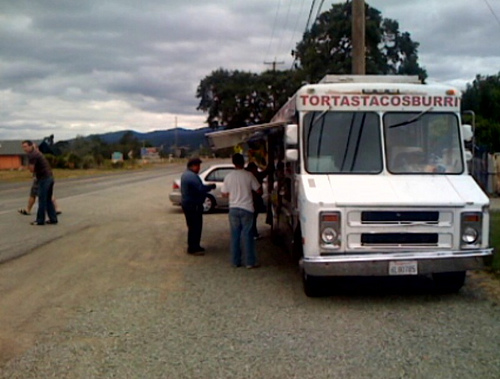
After months of deliberation, earlier this week, the city of Lathrop (population ~17,000, about 70 miles east of San Francisco in San Joaquin County) passed a new city ordinance regulating mobile vendors (read: taco trucks).

The new laws (I’m still trying to get a copy of the actual language of the law) apparently forbids trucks from parking on dirt roads, from having “no visible dents from a distance of 5 feet,” and requiring “that operators should have to undergo fingerprinting and criminal background checks.”

It also reduces the fees from $225 per cart to $21 that are currently doing business in the city, increases how long one vendor can be in a single location from 10 to 30 minutes, and restricts vendors from “setting up within 300 feet of any intersection and within 500 feet of other vendors or school areas. They will also be required to provide bathrooms for their employees and clean up all trash,” according to the Sun Post.

The measure passed the city council 3-1, with one member absent.

Councilwoman Martha Salcedo argued that the new rules are unfair and that there was a high potential for legal action against the city. At a previous council meeting, Salcedo asked why taco trucks were being targeted.

“Why just the vendors?” she asked. “In my opinion, it seems the vendors are being picked at. It should be all businesses. It’s all about being fair.”

Given the recent legal battles in Salinas and Los Angeles, she’s probably not wrong.

[Photo credit: Denise Ellen Rizzo/Sun Post]

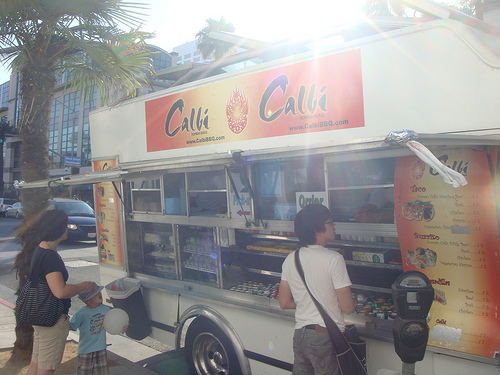
West LA restaurants fight proliferation of food trucks

Posted by Cyrus Farivar on August 27, 2009

It was only a matter of time before the traditional brick-and-mortar restaurants started getting their napkin rings in a twist over all the new taco trucks. The first area to complain? West Los Angeles’ Mid-Wilshire district, where such fine eating establishments like Toshi’s Fresh Asian, Koo Koo Roo, Baja Fresh and Johnnie’s New York Pizzeria have banded together to complain.

Last Wednesday, the Los Angeles Police Department arrived to dish out tickets to many of the trucks. And they didn’t come with a side of friendliness, either.

“They don’t have city and health department permits,” said Lt. Dan Hudson, watch commander at the Los Angeles Police Department Wilshire Division, who was quoted by the LA Times. “Restaurants complain because the lunch trucks are taking their business, and they don’t have [proper] permits.”

The paper added:

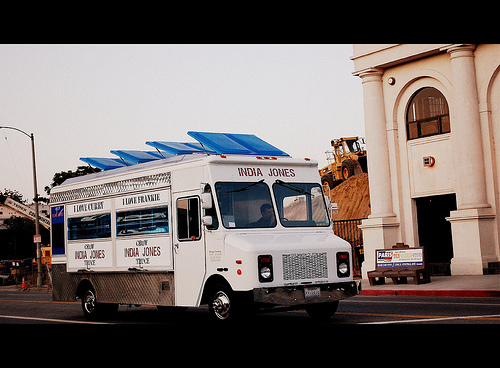
Sumant Pardal said the truck he leases to operate India Jones food catering [pictured] was impounded after police told him that “businesses don’t want you guys here.”

Pardal, who said he recently moved from Arizona and had been operating India Jones for a little more than a week, said he was cited for failing to have a California driver’s license and vehicle tags.

“They were trying to find any reason to cite me,” said Pardal, who said he’s been a chef for more than three decades.

[Note: We'll have an email interview with Sumant Pardal coming soon.]

Interestingly, the article noted that these vendors were seeking advice for the first time from the newly formed Asociación de Loncheros La Familia Unida de California. This represents the first significant crossover between these nouveau food trucks and the existing Latino trucks around the Southland.

According to LAist, the local restauranteurs are upset:

“They’re only picking on us apparently,” said Toshi’s General Manager, Fred Williams, who thinks all the recent criticism has been unfair. “We’re actually not the ones who called the police [on Wednesday]. All the restaurants here have been complaining about the trucks. We gave up on it a long time ago. We really haven’t been doing anything about it.”

And that’s true. Jose Ceja, the manager over at Johnnie’s New York Pizzaria, says all the restaurant managers in the area, including Koo Koo Roo, Baja Fresh and Organic to Go, have been meeting over the issue. “We’re all trying to work together getting rid of these things,” explained Ceja. “I’ve cut employees left and right because we don’t have enough income to keep everyone here. The economy has been bad and I had to cut, and then these trucks show up and had to cut more. We all average $15,000 to $18,000 in rent, have to pay employee taxes and alcohol licenses.”

I also checked in with LA taco truck lawyer extraordinaire Phil Greenwald, who said that this enforcement might not hold water in court.

He emailed me with the following reaction:

LAMC 80.73b2f (Time limit parking of catering trucks on the streets of Los Angeles) was considered by Superior Court Commissioner Barry D. Kohn on June 10, 2009. He dismissed the citation against the driver of the truck on the grounds that the ordinance was not in conformity with the California Vehicle Code. He held that the time limits were not rationally related to “public safety” as required by applicable Vehicle Code Sections. The “one day” sweep of catering trucks along Wilshire Blvd. appears to have been applied in a discriminatory manner since all vehicles parked along that street were not treated similarly. California Appellate Court Decisions do not permit discriminatory enforcement.

For the record, here’s the language of LAMC 80.73b2f:

F. (Amended by Ord. No. 177,620, Eff. 7/23/06.) No catering truck shall remain parked at any residential location for the purpose of dispensing victuals, or at any residential location within a half mile radius of that location, for a period of time, adding together all time parked at each residential location, which exceeds 30 minutes. Upon the elapse of that period of time, any catering truck that continues to be used for the purpose of dispensing victuals must be parked at a location more than half a mile distant, as measured in a straight line, from the location where the vehicle was parked at the beginning of the 30-minute period, and the vehicle shall not return to that location for at least another 30 minutes from the time of departure or relocation. The requirement that a vehicle must be parked one-half mile distant shall only apply if the new parking location is in a residential area.

No catering truck shall remain parked at any commercial location for the purpose of dispensing victuals, or at any commercial location within a half mile radius of that location, for a period of time, adding together all times parked at each commercial location, which exceeds one hour. Upon the elapse of that period of time, any catering truck that continues to be used for the purpose of dispensing victuals must be parked at a location more than half a mile distant, as measured in a straight line, from the location where the vehicle was parked at the beginning of the one hour period, and the vehicle shall not return to that location for at least another 60 minutes from the time of departure or relocation.

Tacos Arizas feud mediated by Councilmember Eric Garcetti

Posted by Cyrus Farivar on August 5, 2009

Move over Dennis Ross, and meet Los Angeles Councilmember for District 13, and City Council President, Eric Garcetti.

The Eastsider blog points out what may be the world’s first case of taco truck diplomacy as mediated by local public officials.

Here’s the issue: The Tacos Arizas taco truck has apparently been parked at the corner of Sunset Blvd. and Logan St. for years. Each night it welcomes all kinds of folks who want to get their taco on. However, the local residents say that many of these people don’t seem to know how to keep the noise down, nor how to adequately dispose of their basura. Before, when the City of Los Angeles had a one-hour parking limit, the cops could just hit them with tickets all the time. But that law was struck down in June, making it impossible to compel the truck to move.

Garcetti set up a meeting between the Loncheros Association, the LAPD, and his own Council District 13.

The result? The Eastsider reports:

After the discussions, the owners of Arizas agreed to move the truck about a block north to the other side of Sunset Boulevard next to the Sav-A-Lot market and away from apartments and homes. “This was the first time we worked with a taco truck to have them voluntarily move to a location to address concerns of local residents,” said Garcetti’s spokeswoman, Julie Wong.

The taco truck owners are happy with the new location – and not having to contest $158 parking tickets, said Magallenes. “It was a good approach,” he said of the negotiations with the city. “We got good results.”

However, the Arizas truck is now closer to some restaurants but merchants were not involved in the negotiations over the new location, Magallenes said. One resident, who lives nearby, has also noticed that the Arizas truck sometimes parks closer to Sunset Boulevard than called for in the deal with the city.

Hrm. Maybe the new residents can be bought off with free pastor?

[via LA Daily blog]

Rancho Palos Verdes City Council tightens taco truck rules

Posted by Cyrus Farivar on February 25, 2009

This just in from The Daily Breeze:

This week, the Rancho Palos Verdes City Council unanimously approved an ordinance that requires the trucks to park within 200 feet of a restroom that employees and customers have written permission to use.

The rules are a tightening of those created in 2006 that require catering vehicles to move at least 500 feet every 10 minutes – a requirement that for a time discouraged truck owners from operating in Rancho Palos Verdes, much to the satisfaction of residents who had complained about the lunch scene.

My guess is that none of the city council members in this uppity, ritzy neighborhood of Los Angeles County have ever eaten at a taco truck, otherwise they’d probably know what every taco truck patron and owner knows: 10 minutes is absurdly short.

Further, this new legislation is likely bordering on violating state law, says taco truck legal crusader, Phil Greenwald, in an interview with The Daily Breeze:“It is so outrageous, it tests credulity,” Greenwald said. “This (Rancho Palos Verdes) ordinance is apparently a thinly veiled attempt to restrain trade. It would effectively prohibit mobile vendors from exercising their right to participate in a lawful occupation.”

adding: “How many restrictions do you need before you realize that the purpose of the law is not for the public safety but it is to drive street vendors out of the city?”