Archive for July, 2009

Lomo Arigato: Interview with Eric Nakata

Posted by Cyrus Farivar on July 30, 2009
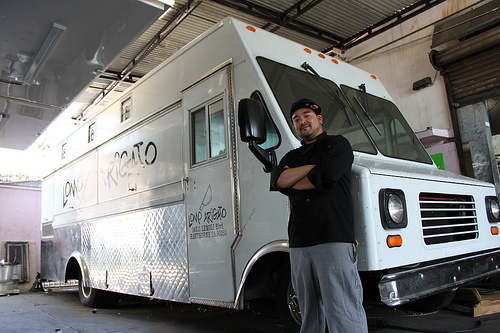
Oh man, as soon as I heard about Lomo Arigato, I knew there had to be some awesome background to this Japanese-Peruvian fantastic food truck. I pinged owner Eric Nakata for the deets.

1) What is Japanese-style Peruvian food? Did you create this, or is this something that exists amongst the Japanese people of Peru? Are you Japanese-Peruvian? Do you speak both Spanish and Japanese? What’s your background?

My name is Eric Nakata, born in the South Bay, raised in West L.A., and a life-long Angelino. I am fully Japanese-American with family from Japan to Peru. I speak both English and Japanese fluently.

2) What gave you the idea of creating this? Does such a thing exist in Peru? How big of an influence were existing taco trucks, and/or Kogi? How do you feel about this sudden trendy-ness of LA mobile food vendors?

Peruvian cuisine is known for the fusion of its many immigrating cultures. Japanese and Chinese have major influence on some of the most well-known Peruvian dishes. Actually, I’ve had this idea for some time, since my last trip to Japan in early 2008. On almost every corner, the Japanese street food vendors dished out their own unique creations that attracted happy crowds. L.A. has the happy crowds, and night life, but are thirsty for more.

The L.A. mobile food movement has not only spawned great creativity in the food it offers, but has also provided a window of networking among our tech-obsessed culture.

As for Peru, their street food vendors are as common as they are in Japan.

3) What customizations have you had to make on the truck? How much has it cost you in order to get it up and running? When/where will you be launching?

Unlike other traditional trucks, we installed large glass windows, and moved the kitchen to the street side, fusing the open-kitchen concept to this truck. This will allow customers and passersby to see the action. Like any starting business, it costs a pretty penny.

My routes will run from Downtown to the West side, and will definitely make a few South Bay stops. Check out lomoarigato.com for weekly stops. If everything goes as scheduled, we are looking towards mid-August for the grand opening!

4) What does Lomo Arigato mean?

4. Lomo Arigato = Lomo Saltado + Domo Arigato

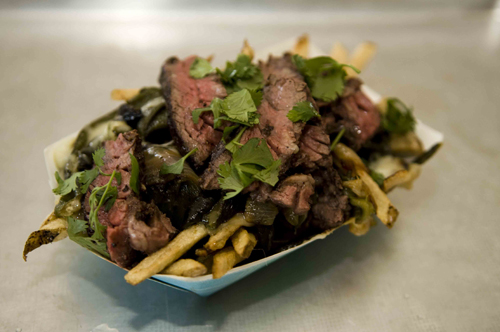
Lomo Saltado is our signature dish which is sauteed strips of tri-tip seasoned and tossed with onions, tomatoes, cilantro, french fries, red wine, and soy sauce.

Domo Arigato is Japanese for “Thank you very much!”

5) How insanely spicy is the insanely spicy green sauce? What best does it go with?

5. Currently, I am working on two types of green sauce: “weak sauce” for the norm, and “kichigai” for the strong. (kichigai = insane >_< )

Both sauces compliment any and every dish!

Frysmith: Interview with Erik Cho, co-owner

Posted by Cyrus Farivar on July 29, 2009

About a week ago I got an email about Frysmith, a new “ethnically-infused” fry truck soon to be launched in Los Angeles. Curious, I fired off a barrage of questions to Erik Cho, a co-owner.

1) Ethnically infused fries? Huh? How do you pick who makes the cut and who doesn’t? How much are they? What’s the best way to eat them? What are they made from?

Okay, “ethnically-infused” is something my buddy in marketing came up with. Who knows what that actually means, and come to think of it, I think that dude markets mostly women’s hair care products, so I shouldn’t have taken his wording advice. Basically, I just figured fries were an awesome blank slate for toppings and proceeded from there with the kind of aggressive flavors that I grew up around in LA. They’re best eaten with a fork. Unless you like chili hands. The fries are hand-cut Kennebec potatoes cooked in canola oil.

2) What gave you the idea of creating this? How big of an influence were existing taco trucks, and/or Kogi? How do you feel about this sudden trendy-ness of LA mobile food vendors?

Brook and I have thought about starting a food business for years but never had the balls to do it. When we were in school at Berkeley, I had an idea for a push-cart with soups. I wanted to be a traveling campus soup Nazi, but anyone who knew me in college can tell you I wasn’t particularly motivated in those days.

I’ve been hitting taco trucks for years, and I love that it takes less than a minute from when the meat hits the tortilla to when the tortilla hits your mouth. That idea is perfect for something like chili fries. If they sit around, they get soggy, but if you get to them right away, there’s a perfect blend of soft and crunchy.

Kogi was huge for us and everyone that’s involved in the LA mobile truck movement (and I guess movement is just a fancy word for big-ass trend). LA’s long been a taco truck town, but Kogi showed that the sky’s the limit if you can pair a good concept with good food and four wheels.

3) When do you launch? Where/when will you be operating? How do you choose you’re route?

We’re getting delayed on the launch due to backorder of some equipment for our truck. It sucks, but we still hope to get going by late August. We’ll keep everyone informed on our site and through Twitter. Our plan is to be all around town chasing events and crowds for the first couple of months to build awareness. Then, we’ll probably settle on some weekly locations. We’re open to suggestions.

4) What did you do before you started the truck? How much did it cost? What’s surprised you about cooking/operating a truck?

Before the truck, I worked in the film industry and Brook was a magazine editor. The truck cost a lot, but we got a steal on the truck itself and good pricing from the builder to make it work in our pretty limited budget. As a first-time small business owner, there are so many more things to take care of than I imagined, and we haven’t even hit the road yet.

5) What beers do you recommend that I pair with your fries?

It pains me that I can’t offer beer with the fries, but we’re doing some kick-ass soda pairings to make up for it. If I could sell beer…the chili cheese fries would be nice with an Alaskan Smoked Porter. Kimchi pork makes me want something dry and light, like a Sapporo. For the rajas, you can’t go wrong with the classic Corona and lime but something real bitter, like a Green Flash West Coast IPA is an interesting contrast. The sweetness and fruity complexity of Lost Abbey would be my choice for the chicken tomatillo sweet potato fries. For the vegan chili, maybe a Fuller’s ESB. In the end, though, they’re fries, man. And fries taste good with pretty much whatever beer’s in your hand.

Sam’s ChowderMobile: Interview with Julie Shenkman, co-owner

Posted by Cyrus Farivar on July 28, 2009

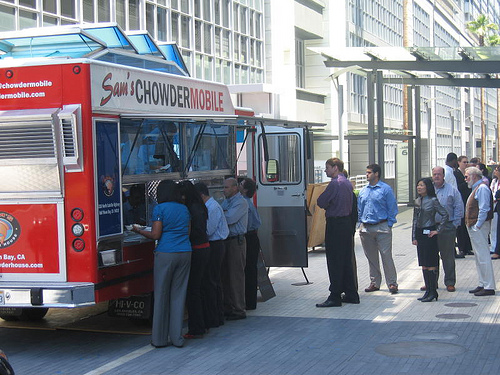
In our continuing series of five-question email interviews, I dropped a quintent of queries to Julie Shenkman, co-owner of Sam’s Chowder House and Sam’s ChowderMobile in Half Moon Bay, Calif. This is the Bay Area’s first mobile gourmet seafood truck.

1) A ChowderMobile? Huh? How’d this all get started? Why a truck, and why a truck now?

Well, we’ve actually been working on it for a little over a year now. We opened Sam’s in October of 2006, and we continually hear from customers that they love it, and “man, I wish there was something like this in (my city)” and we thought, well…why not? A truck seemed the perfect solution, and the idea grew from there.

2) Is there anything easier or harder about cooking chowder in a truck? Aren’t liquids dangerous in a moving vehicle?

We actually prepare the chowder in our main restaurant in Half Moon Bay, and then we heat it on the truck. It’s not difficult at all, as we heat it in a large pot, and then transfer it to a large, converted built-in coffee urn
that we had customized for this purpose, and we serve it from that. The coffee urn was designed to be stable during travel, so it works great.

3) What’s your route? How do you determine it? Do you only do private events? And when will you be back in SF, or more importantly, in Oakland, where I live? :-)

During the week we will be at company campuses and large business parks across the Peninsula for lunch and (soon) dinner, such as Robert Haft International, Genentech, Intuit, etc. We are in the midst of expanding our route now based on incoming requests we are getting, so it’s largely based on customer feedback and demand. Customers can email us at route@samschowdermobile.com to request to be added to our stops. We also do private events on a scheduled basis, such as we just did a private Lobster Clambake in Atherton, and one for Intuit, as well as a private event for Ideo (SF) and Catholic Healthcare West (SF). We will be back in San Francisco in the coming weeks. Oakland is not part of our regular route, but we’ll be at the Eat Real Fest in Jack London Square in Oakland, on Saturday/Sunday August 29 and 30. Also August 7-9, we’ll be at the San Jose Jazz Festival, and August 15-23 we’ll be at the Santa Clara County Fair, and September 18-20 we’ll be at the Monterey Jazz Festival.

4) What’s the best item on the menu?

Depends on who you ask! I personally love the fish tacos and lobster roll :-)

5) What’s the most surprising thing you’ve learned by operating a truck?

One is that it’s important to economize on time – so we are trying to schedule a route that makes sense for our staff and our customers. We are finding that it sometimes makes sense to visit multiple locations within one campus to serve a good part of the customer demand at a particular company. Also to have regular stops at companies, so they can plan to visit the ChowderMobile on that particular day. Second is the response – it’s overwhelming — we can’t believe how jazzed people are by it. It’s sort of its own advertising (being lobster red doesn’t hurt).

Baja Fresh introduces ‘Baja Kogi Gogi’ burrito

Posted by Martin do Nascimento on July 27, 2009

It is unlikely that when William Shakespeare wrote that now famous phrase “what’s in a name?” he had Korean Tacos in mind. Yet, there are hardly better words to express the controversy that has arisen around the word ‘Kogi’ in the world of tacos in the past few weeks.

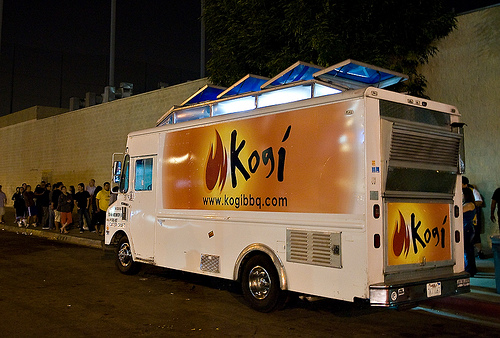
It is quite possible that frequent readers of this taco-loving publication will recognize the word from a number of Korean taco-related articles recently published herein. Kogi BBQ, the Los Angeles based Korean BBQ taco truck that communicates its location to interested clients via Twitter, has received a lot of face time on this blog and elsewhere as a result of its innovative adaptation of Korean BBQ to the taco and the taco truck. Not only has the concept inspired some taco lovers to attempt to replicate Kogi BBQ’s recipes at home–especially we taco-deprived easterners–but it has even resulted in the spawning operations (see May 13th and May 31st posts).

Amazingly, some non-wheeled taco establishments have even begun picking up on Korean BBQ tacos. Recently, Baja Fresh the ubiquitous 300+ unit Tex-Mex burrito-and-taquería announced that it would begin serving its own version of Korean BBQ tacos under the name ‘Baja Kogi,’ as evidenced in the photo above.

Were it the case that Baja Fresh were simply adopting the Korean taco from Kogi BBQ as has already been done by other taquerías, what has become a major controversy may never have reached this blog as it there would have been no question as to the legality of the Baja Fresh’s actions. The origin of the controversy is to be found, however, in the adoption of not only the style of taco but also its name ‘kogi’ by Baja Fresh.

As I’m told, many copyright infringement proceedings are clear-cut cases, this one is not due to the meaning of the word Kogi in Korean: meat (고기). Does Kogi BBQ have exclusive rights to the word as a consequence of being the first firm to offer the Korean BBQ taco under that name? Whereas a word such as ‘meat’ or ‘vegetable’ could never be copyrighted in English, does the fact that the word ‘kogi’ is more widely recognized as a brand name than as a word mean that it is trademark infringement? These are questions that remain to be answered.

Update 9:35 am Pacific: Melanie Wong points out that Baja Fresh is now calling them ‘Baja Gogi‘ and not Baja Kogi. According to LAist, Chuck Rink, president of Fresh Enterprises, which owns Baja Fresh, released a statement clarifying what his company is doing:

Baja Fresh wants to clarify that our Korean BBQ style “Kogi” chicken and beef tacos and burritos, concept testing right now in one Irvine store, was by no means intended to seem “stolen” from the famous LA-area Kogi taco truck.

Rather, we were under the impression that “Kogi” was the generic word for Korean BBQ style. We have since learned “Gogi” is the general word and will be moving to change our naming to Gogi, for the Irvine store, and for any future roll outs of these products.

I’m still not sure what the difference between a “generic word” and a “general word” are, but whatev. -CF

Interview with Juan Posada, Los Angeles Taco Truck Photographer

Posted by Cyrus Farivar on July 22, 2009

I recently came across the new site of the Asociación de Loncheros, the new site of the organization of taco truck owners in Los Angeles. Their meetings and corresponding trucks have begun to be photographed by Juan Posada, a Colombian wedding photographer who has lived in Los Angeles for a long time. I shot him my standard quintet of questions to see what he was about:

1) Your day job is as a wedding photographer. How did you first become interested in photographing taco trucks? What are your favorite ones to shoot? What’s different in how you shoot weddings versus taco trucks?

I became interested in photographing taco trucks after attending one of the “Asociacion de Loncheros” community meetings. I was searching for a photographic project and after meeting the taco truck owners and getting to hear about their struggles I immediately got interested. My approach to photographing a wedding is not very different to the way I take pictures of the taco trucks. In both circumstances I am documenting people’s lives and telling their stories through pictures.

2) What is unique about Los Angeles taco trucks? Have patrons/taco truck owners ever been wary about you taking pictures of their craft?

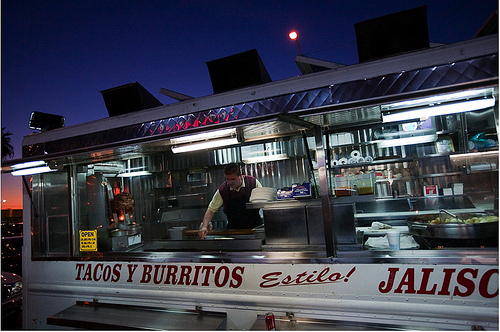
What makes taco trucks unique is the people; the people that work in them and the patrons that visit them. They bring life to streets that otherwise might be dead. The flicker of the grill, the fluorescent lights, the smell of carne asada and people gathered around food enriches the urban experience of many people in Los Angeles. I always establish contact with the taco truck owners before taking photos at their truck. So far patrons haven’t been wary of me photographing them. I always make it obvious that I am taking photos and sometimes tell them what I’m doing, if I feel it’s necessary.

3) I see that you’re from Colombia. Does Colombia have taco trucks or other similar types of street food? How does your background influence your interest in taco trucks?

Colombia doesn’t have taco trucks as we don’t have tacos, but we do have a lot of food on the street. Hot dogs, skewered meat, empanadas, arepas, etc. are ubiquitous. You can always find good, cheap food on the street. Being far away from my country, makes me long for the warmth of the Latino culture and I have found that in my encounters photographing the taco trucks.

4) Have you seen any trends/unique aspects of trucks from behind a lens that the untrained eye might miss about these trucks?

What catches my attention about the taco trucks is that they are restaurants on wheels. They have running water, hot and cold, sinks, freezers, grills, etc. What people probably don’t realize is the amount of work involved to put one of these trucks on the street. There is extensive work before and after. The normal work shift is 12 hours.

5) Any advice for the amateur photographer who wants to shoot at or around their local truck?

Just introduce yourself before you shoot and explain why you’re interested in taking pictures.

Interview with Nom Nom, the new West LA bánh mì truck

Posted by Cyrus Farivar on July 16, 2009

In my continuing series of interviews with taco truck-related folks, I bring you the latest email interview with Nom Nom, a soon-to-be launched bánh mì (Vietnamese sandwich) truck serving West Los Angeles. The questions were answered via email by David Stankunas (above), one of Nom Nom’s founders.

1) How’d Nom Nom get started?

I came up for the idea for Nom Nom while having lunch with fellow co-founder, Jennifer Green, on a rainy March afternoon. As we were eating, I mentioned I had recently eaten at a popular taco truck, Kogi, the weekend before. At that same moment, Jennifer was reminded that she just happened to bring a few banh mi (Vietnamese sandwiches) from Westminster for me to take home after lunch. I’ve always loved banh mi, but since there aren’t any places in West LA that sell them, I usually had to drive a long ways to get one. Everything sorta just came together after that. Excited, I rushed home to do a little research on truck costs, permits, and other “alternative” trucks in Los Angeles. I also quickly shot off an email to the Kogi founders for some advice. Later that day I enlisted the other co-founder, Misa Chien, onto the Nom Nom team, and now, close to 5 months later, we’re on the verge of launching our first truck!

2) Were you guys crazy taco truck fans to begin with? How much did Kogi and/or other non-taco food trucks influence you?

Kogi was an incredible influence on us. In fact, I would go as far as saying they are the main reason we are doing what we are doing today. Not only did Kogi serve as inspiration for starting our Nom Nom Truck, they were also incredibly helpful and supportive when it came to offering advice on how to get started. We’re all big fans of Kogi, their food and their people. What they’ve been able to do in such a short period of time is nothing short of amazing. In my eyes, they are responsible for the whole mobile food “movement” that has become so popular in Los Angeles today. I like to refer to them as the “Godfather” of mobile food trucks.

Continue reading »

Taco Trucking in Tulsa

Posted by Martin do Nascimento on July 7, 2009

Although I’m not certain that it’s kosher to order hot dogs (‘Mexican’ or not) whilst on a taco crawl, here’s a neat account of what a crew from the Tulsa World recently termed their Tulsa Taco Truck Trek. If you live in Tulsa, Oklahoma or plan on passing through in the near future, decide which taco truck(s) you’ll want to visit with this handy overview:

Video highlight:

“Tacos de cabeza [brain/head]? I’m not sure what that is. I bet it’s good, though!”


video platform
video management
video solutions
free video player