Archive for September, 2009

SFWeekly’s John Birdsall (see our interview with him from February 2009 here) blogs that last Friday, the San Francisco Recreation and Parks Department modified its solicitation for proposals to include Golden Gate Park. Previously, the solicitation had included all other SF park, save the mother of all City parks.

Further, the deadline for applications to vend in said parks would be pushed back from October 1, 2009 to October 15, 2009.

However, the R&P Dept. has made clear that it’s only interested in one operator for each park. However, that operator could have multiple concession stands.

So, theoretically a large taco truck empire like El Tonayense could expand its empire in various points of the park, or as Birdsall points out, La Cocina could act as the operator while its vendor members could sell individually. Or maybe there will be some kind of Transfomers-esque culinary collective.

Birdsall also has a revealing interview with Happy Belly owner Dennis Lee, the last former legal food vendor in Golden Gate Park — who operated there from mid-2006 until June of this year.

“I would say just realize this is not a normal landlord,” Lee told SFoodie, referring to Rec and Park. “It’s like going into business with the DMV.” The chef described a litany of frustrations he experienced with the city department, from limiting the kind of signage the Happy Belly carts could display to reluctance to intervene when hostile groundskeepers turned the sprinklers on in what Lee called acts of harassment.

Post to Twitter Tweet This Post

Vendrification: Nouveau food truck backlash

Posted by Cyrus Farivar on September 29, 2009

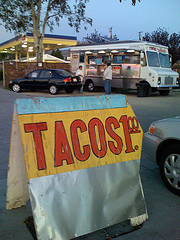
[Photo: Steve Lyon]

This term exactly encompasses what I’m afraid of in this new generation of food trucks popping up around the country. I want to believe that the market is big enough for all type of taco trucks, food carts, and everyone in between.

In California, the only example that I’ve seen so far was the recent Mid-Wilshire spat — but in New York things are a bit more heated between established and nouveau street food.

Still, this piece does give me pause:

In a city accustomed to gentrification, perhaps this new phenomenon could be described as “vendrification,” with more expensive, higher-tech carts and trucks sweeping in and shaking up the culinary terrain of the streets. Predictably, this shift has led to some tensions between the “traditional” vendors and the newer-style sellers, who often use heavily decorated trucks, rotating seasonal offerings, and regular Twitter tweets advertising their current whereabouts to draw in customers. For the kebab and hot dog vendors, who often stay in the same city-assigned location day after day, it becomes a question of market infringement. In late June, an exchange over turf outside the Metropolitan Museum between the fancy food truck Street Sweets and a few other vendors grew so heated that police were called to the scene. And the Schnitzel & Things truck has endured confrontations both with halal vendors and a Mister Softee truck.

[via The Food Section]

Post to Twitter Tweet This Post

California Council for the Humanities grant submitted!

Posted by Cyrus Farivar on September 25, 2009

Amigos y Amigas,

For the last couple of weeks, I’ve been working on a grant to produce a one-hour, bilingual radio documentary about the history of taco trucks in California. I’m pleased to announce that I’ve just submitted it to the California Council for the Humanities!

Here are the opening paragraphs of our grant application:

In California Spanglish, they’re known as loncheras. But in English, they’re known simply as taco trucks. Regardless of what you call them, most Californians simply call them delicious. Given their origins in Mexico, a dash of Americanizations and a kitchen on wheels, taco trucks are the perfect trans-cultural metaphor for California. They represent cheap, quality street food that has spread from Calexico to Yreka and beyond — California Taco Trucks will tell their fascinating story. California Taco Trucks is a sound-rich, narrative-led public radio documentary in both English and Spanish that will describe the rich history and newer incarnations of taco trucks.

With their humble beginnings as a blue-collar staple of journaleros statewide, taco trucks have since crossed socio-economic and cultural boundaries as more non-Latinos have discovered them. Further, as these trucks become more prevalent, cities like Turlock, Salinas, Stockton and even Los Angeles have battled with taqueros over how, when and where taco trucks can operate. Finally, many around the state have adapted the trucks to create new types of fusion cuisine served from a taco truck, such as Korean-Mexican (Kogi BBQ), Chinese-Mexican (Don Chow Tacos) and Japanese-Peruvian (Lomo Arigato).

Taco trucks represent a fascinating and unique lens through which to understand food culture, immigration, and demographics of late 20th century and early 21st century California. While taco trucks exist in other parts of the country, their presence originated in California. Raul Martinez is believed to have opened the first taco truck – converting an ice cream truck — outside of an East Los Angeles bar in 1974. He went from $70 in sales that first night to controlling a small empire of 10 King Taco restaurants and trucks around Southern California. By 1987, Martinez had earned $10 million in sales across his various properties. Nearly all taco truck owners don’t establish vast empires à la Martinez. Most are family-run businesses that work long hours and earn slim margins on a product that sells for around a single dollar.

Today, taco trucks exist in probably all of the 50 states, however, their largest concentration is in the Golden State. Los Angeles County alone has over 7,000 taco trucks, according to the newly founded Asociación de Loncheros – the rest of the state likely hosts thousands more. While taco trucks have existed for decades, the association itself was founded in 2009 after many loncheros found themselves afoul of new laws making it harder for them to operate in the City and County of Los Angeles. They have worked with attorneys in Los Angeles and Stockton, as well as UCLA law students to fight back and have struck down unconstitutional laws that restrict their trade.

Since the founding of Kogi BBQ, a Korean-Mexican taco truck in Los Angeles that famously uses Twitter to advertise and stay connected with its customers, dozens of nouveau food trucks have sprung up. They sell various treats including Indian cuisine, Mexican-Asian fusion, ice cream, shaved ice, burgers and various other combinations. However just as the classic trucks before them, this small community of newer trucks has to navigate an oft-confusing sea of municipal and county codes. These new trucks have received national media attention, and although they represent a small minority of the California taco truck community, they may just represent where it is headed both in California and on the national scale.

I’m supposed to be notified if we will receive the grant before December 2009.

If accepted, I will be working with Robert Breuer who will serve as photographer and associate producer.

We’re grateful to have received the support of the Asociación de Loncheros, who will act as the sponsoring organization. Our humanities advisors will be Prof. Abel Valenzuela (UCLA), Mark Vallianatos (Occidental), Prof. Roberto Alvarez (UCSD) and James Rojas (Latino Urban Forum). We will also be receiving culinary consultation from Bruce Aidells (Aidells Sausages) and Melanie Wong. We’ve also received letters of support from the Public Radio Exchange and NPR’s Latino USA.

Clark Boyd has also agreed to serve as script editor and Robin Wise will be our sound engineer.

Muchas gracias to Julie Caine for all her help. She successfully got her radio doc, “Squeezebox Stories” funded last year.

Keep your fingers crossed! Here’s to hoping we get it!

Post to Twitter Tweet This Post

Lathrop, Calif. passes new taco truck rules

Posted by Cyrus Farivar on September 18, 2009

After months of deliberation, earlier this week, the city of Lathrop (population ~17,000, about 70 miles east of San Francisco in San Joaquin County) passed a new city ordinance regulating mobile vendors (read: taco trucks).

The new laws (I’m still trying to get a copy of the actual language of the law) apparently forbids trucks from parking on dirt roads, from having “no visible dents from a distance of 5 feet,” and requiring “that operators should have to undergo fingerprinting and criminal background checks.”

It also reduces the fees from $225 per cart to $21 that are currently doing business in the city, increases how long one vendor can be in a single location from 10 to 30 minutes, and restricts vendors from “setting up within 300 feet of any intersection and within 500 feet of other vendors or school areas. They will also be required to provide bathrooms for their employees and clean up all trash,” according to the Sun Post.

The measure passed the city council 3-1, with one member absent.

Councilwoman Martha Salcedo argued that the new rules are unfair and that there was a high potential for legal action against the city. At a previous council meeting, Salcedo asked why taco trucks were being targeted.

“Why just the vendors?” she asked. “In my opinion, it seems the vendors are being picked at. It should be all businesses. It’s all about being fair.”

Given the recent legal battles in Salinas and Los Angeles, she’s probably not wrong.

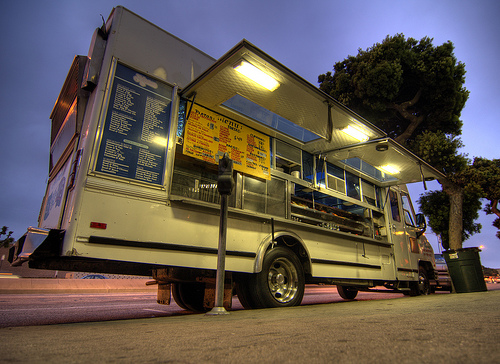
[Photo credit: Denise Ellen Rizzo/Sun Post]

Post to Twitter Tweet This Post

33 Stewart Avenue: Interview with Sean Finocchio

Posted by Cyrus Farivar on September 17, 2009

Just around the time that twittering taco trucks took off, Los Angeles artist Sean Finocchio started doing this series of taco trucks. From his website you can get one for $25 or a pair for $40. I’m *this* close to forking over the money to get a couple. I think they’d look great in my kitchen or bathroom. I hit him up for a query-laden quintet.

1) How did you come up with the idea to do taco truck prints?

I spend a lot of time in my car commuting to and from work. I take a camera with me daily to take pictures. Taco trucks kept showing up and I decided to do a series of them. I had previously done a series of mobile homes. The taco truck series was completed back in the fall of 2008. Most of my artwork is of everyday life in and around Los Angeles. Markets, Liquor stores, alleys, apartment buildings, etc.

2) How are these trucks selected? Where are they located? Are they your favorites?

All of my images are completely random. They are just trucks seen around town. Some were found downtown, Hawthorne, Mar Vista, Venice, Hollywood, etc. Taco Trucks are everywhere in LA. I’ve also changed the names on all of the trucks. I have taken some creative liberties while creating these images. My artwork celebrates the culture of the taco trucks — not necessarily a specific truck.

Full disclosure on the taco truck series — I’ve changed the names on all of the trucks. All the names are fictitious. I didn’t want to exploit these trucks because I realize these are family run trucks (usually) and I did not get their permission when taking the pictures. I didn’t want to get in a legal mess. So — you wont find these exact trucks around town. They do exist, but I don’t remember exactly where they are located. And finally, the red truck and the yellow truck were not actually taco trucks but a fire and rescue truck and a delivery truck. I was looking to complete a set of trucks and needed to find a few more — most of the trucks I came across are all the same shape and I wanted to have some different looking ones.

I’m telling you all of this because your site appears to celebrate specific trucks and I don’t want people to ask you or me what part of town “La Mexicanita” is at on Tuesdays. I’m not trying to be accurate- I’m an artist. My artwork really is just to celebrate the beauty of the taco trucks and the culture — not any truck specifically.

3) How many of them have you sold? Have you ever given/sold to these (or other?) taco trucks?

Taco trucks are pretty popular right now. It has been a happy accident. I’ve sold quite a few of these locally and nationally. People tell me they like them because of their love for LA and their love of taco trucks. I haven’t approached any of theses taco trucks with my artwork. If they were interested in one of my print I would gladly give them one or trade for some tacos.

4) What’s most visually appealing about taco trucks for you?

I’m attracted to the different shapes and colors of the trucks and the artwork on the sides of the trucks. It is a completely random process. I usually spot a cool truck and take a picture from the other side of the road and keep going. Unfortunately I haven’t eaten at any of these trucks.

5) Are you going to do another round, given the new twittering generation of trucks?

I might do a different series in the future. I take pictures daily and I have a bunch of new images that I have taken in the last few months.

Post to Twitter Tweet This Post

The Gastrobus: Interview with Antonio Medina

Posted by Cyrus Farivar on September 15, 2009

Earlier this summer, a former Wolfgang Puck chef, Antonio Medina, started The Gastrobus, a fun new mobile restaurant roaming the streets of Los Angeles. I hit up Medina for the standard fiver.

1) Gastrobus? Is it really a bus or a truck? How’d you get that going? Why a bus? How’d you convert it?

The Gastrobus is a truck, it just took a paint job and a name to turn it into a school bus. The idea came from the need to work together as a family. The name is a play on words ‘gastro pub’, which is the type of restaurant we wanted. School busses are also cool looking and familiar to everybody.

2) Tell me about yourself. What’s your cooking/food/eating background? What’s the biggest difference cooking in a truck/bus rather than restaurant kitchen?

I have been cooking professionally for the past 7 years, during which I was the Executive Chef for Wolfgang Puck at the Pacific Design Center, worked for catering companies in Hollywood and at a couple of restaurants in the city. The food at the Bus is my take on American gastro pub fare, accentuated by my Latin roots.
Kitchens are kitchens, whether it’s a five star restaurant, a catering company, a pizza joint in the Caribbean or a Bus. I just do my best with I have.

3) Man, root beer floats! I love it! Are those difficult to concoct on a truck? Is there room for a freezer? What kind of ice cream/root beer are you using?

Floats are an American summer classic. We tasted many root beers and ice creams (big brands and microbrews) and nothing beats A&W with homemade vanilla ice cream. There’s no freezer in this truck, but we know how to keep things cool at The Gastrobus.

4) How’d you pick your menu items? What’s the difference between the regular menu items and the Los Feliz Farmer’s Market menu items? What are the specials and how do we find out about them?

The menu looks really simple, but all the items have been thought thru, from the bread to the garnishes, each component adds some flavor/texture to them. “Organic Sundays” is our new project at Farmers Markets, and is completely improvised each time. Sunday mornings we shop at the market and whip up small plates using the best local produce that the farmers bring. It is a very interesting approach to the “market-driven” concept that some restaurants have. Check out the website for menus, bus stops and our latest creations at the Farmers Market. Or follow us on twitter (@thegastrobus).

5) What are your favorite food/taco trucks in LA?
Coolhaus! They have the best sweets on the road.

Post to Twitter Tweet This Post

CBC Spark – Cyrus reports on twittering taco trucks

Posted by Cyrus Farivar on September 11, 2009

Amigos, this weekend marks the premiere of the third season of CBC’s (that’s the Canadian Broadcasting Corporation, folks) tech culture show, “Spark.”

They’ve got a new time slot (Starting September 13: Sunday afternoons on CBC Radio One at 1:05/1:35 NT (4:05 PT) and/or Tuesday afternoons on CBC Radio One at 3:05/3:35 NT) and have been expanded from a half-hour to a full hour.

Regardless of where you are, you can listen to the show — right now! — here, or via podcast.

In Episode #84, I close out the show with this little report on California’s new twittering taco trucks — my report starts at minute 44.

Much love goes out to Kogi BBQ and to Don Chow Tacos for making these interviews possible. (And if anyone knows how to find Joseph Santos in Palo Alto, tell him he’s on Canadian radio!)

Incidentally, my good friend Lisa Morehouse did a similar report on San Francisco’s twittering food trucks and carts too, on this week’s episode of The California Report.

Tacos + Radio = ¡Delicioso loco!

Also, join my CaliforniaTacoTrucks.com Facebook fan page!

Post to Twitter Tweet This Post

Buttermilk Truck: Interview with Gigi Pascual, owner

Posted by Cyrus Farivar on September 11, 2009

While most trucks tend to be lunchtime or late-night operations, a new truck is trying to capitalize on the most important meal of the day: breakfast. Enter the Buttermilk Truck. Owner Gigi Pascual served up her story.

1) A breakfast truck? Seriously? Are we talking breakfast burritos here? What’s the deal? What’s on your menu?

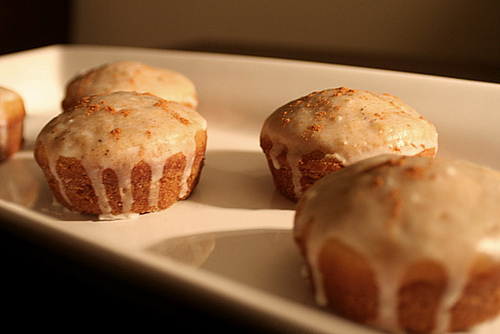
Yes a BREAKFAST truck:) I love breakfast all times of the day especially homemade from scratch recipes. We will be featuring fresh baked and housemade assorted pastries such as scones, breakfast cupcakes [pictured], turnovers, and granola. We will have breakfast sandwiches using applewood smoked bacon, and chicken apple sausage topped with a fried egg and sharp cheddar cheese on our housemade buttermilk biscuits. Also a Portuguese sausage sandwich on hawaiian sweet bread. A vegetarian option is available as well on our housemade corn bread topped with sauteed mushrooms, spinach and pepperjack cheese. Buttermilk pancakes, donuts, french toast sticks are a must as well as omelettes. Our late night menu will replace pastries with our fried chicken and buttermilk cinnamon waffles and something we call the buttermilk “brick”… a stick-to-your-ribs for those late night breakfast cravings.

2) When/where do you launch?

We plan to launch mid-November in West Los Angeles area.

3) What’s your background in food/eating? Why a truck? Why now? How’d you decide to get started? Who’s behind this, anyway?

I graduated from The French Culinary Institute NYC in Pastry Arts. I interned at Nobu NYC and worked as a Pastry Chef at Bin 8945 in West Hollywood. I always wanted my own bakery or breakfast joint but the start up costs were beyond my means. The truck was a feasible way to share my love for pastries and breakfast. It is a meal that is often skipped due to time restraints of our daily routines and our late night breakfast options are
always the same 24 hour joints. I wanted to fill that breakfast void. All the recipes are mine and have been fine tuned over the past years and months. I have close friends helping with PR and marketing. I am currently in the process of hiring my Buttermilk Truck Team.

4) Will you have egg and cheese on bagels like the street carts in NYC? What’s your fav item?

There will be modified versions of that NYC breakfast staple:) My favorite item is the fried chicken and buttermilk cinnamon waffles.

5) How many of your items actually have buttermilk, anyway?

A good 90% of our items contain Buttermilk :-)

Post to Twitter Tweet This Post

Kung Fu Tacos: Interview with Jonathan Ward, co-owner

Posted by Cyrus Farivar on September 8, 2009

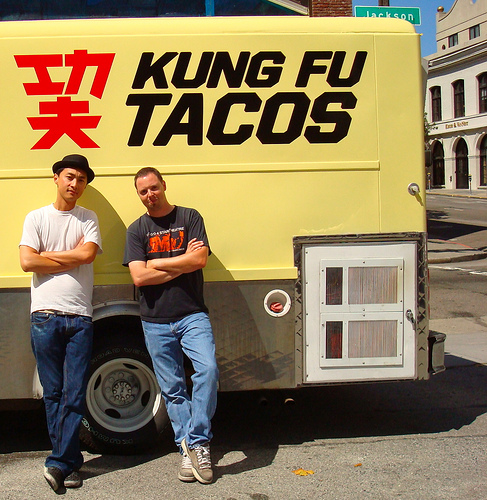
A week or so ago, I came across Kung Fu Tacos, which seems similar to Don Chow Tacos down in LA. Fortunately for me though, they operate within BARTing distance of my house — in SF’s Financial District — obviously I can’t wait to try them out. I hit up co-owner Jonathan Ward (pictured above) for the details.

1) What’s a Kung Fu Taco? What are your various options? What’s on the menu?

Food with fighting spirit. We have a simple menu that we plan to evolve over time with various specials. For now there are 5 options. We have Asian Asada (beef), Nun Chuk Chicken, and Mushu Veggie for $2. The come topped with onion, cilantro, and our spicy Asian salsa. We also have two specialty tacos that are $3: Roast Ruck and Char Siu (glazed roast pork) that are topped with fresh mango salsa, green onion strips and green papaya.

2) How’d you guys get started? What’s your background in cooking/eating?

I have a product management background in the tech industry but have always had a passion for food and cooking. My business partner Tan has his own restaurant called Candybar in SF’s Western Addition.

I had been out of work for a year after the company I was working for folded and Tan was looking for a day time business opportunity. We had been following the popularity of the food trucks both in LA and NYC and we saw that there was a similar niche to be filled in the Bay Area.

3) I love that you guys are finally bringing more of this new taco truck goodness to the Bay. As I live in Oakland, I frequent Fruitvale taco trucks often. What trucks were you inspired by? What are your favorite trucks? How much of an inspiration was Kogi and Don Chow Tacos in LA?

El Tonayense was the first truck I tried when I moved to San Francisco a decade ago and I think it will always be my favorite. As for inspiration, I think that every one of the new generation of trucks owes a debt of gratitude to Kogi for kicking this movement into high gear. I haven’t had a chance to try their tacos myself but I hear they are delicious. We didn’t actually hear of Don Chow until we were well into finalizing the concept for Kung Fu Tacos. I have seen their menu though and it looks interesting. Would love to try their Chimales if I ever get back to LA again.

4) What areas of SF are you serving? Will you be coming to Oakland at all? What has been the most surprising thing about operating the truck?

Right now we are focused on our lunch business in the Financial District of SF. We have a space on the corner of Sansome and Jackson that has been very good to us. We are also working on expanding to do happy hour and after hours business so if anyone reading this has a club or bar with some private parking nearby we would love to talk to you.

No immediate plans to operate in Oakland but anything is possible once we start expanding.

I guess the most surprising thing so far has been the reception the truck is getting. People have been lining up since our second day of operation. We really didn’t expect it to catch on that quickly but are very happy that it did. We are working hard everyday to improve the service and keep the wait times down.

5) What kung fu moves can you do whilst eating a taco?

I have nearly perfected my five fingers of death punch but I haven’t figured out a way to do that and serve tacos simultaneously. Guess it is a work in progress.

Post to Twitter Tweet This Post

India Jones Chow Truck: Interview with Sumant Pardal

Posted by Cyrus Farivar on September 4, 2009

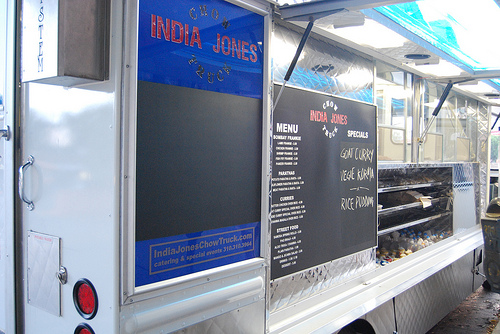
First there was the Dosa Truck. And now, there’s India Jones Chow Truck, bringing more delicious Indian goodness to Santa Monica (my hometown!) and West Los Angeles. I checked in with chef Sumant Pardal.

1) Indian food in a taco truck? Are you serving Indian tacos? What’s the deal here? Why a truck?

Our speciality is a FRANKIE. This is an Indian wrap from the streets of Bombay. Sort of an in between of a taco & burrito, but has no rice & beans. It is an egg washed roti (like a tortilla) with marinated sauteed meats, chopped onions, cilantro, special chutney and a spice blend. Once you have one, you want another one. A truck is exciting. And I have location, location, location.

2) Do you have any regional specialties? Where is the chef from? What’s your background? How’d you decide on the menu? How does real Indian street food impact what you choose to sell?

I am from Jaipur, India, 33 years of experience, and have owned 12 restaurants in LA in the last 22 years,
including East India Grill, which I opened on 8.8.88.

3) How much of an influence was the Kogi BBQ truck? How did you decide on your route? Do you have a set location/route? Being from Santa Monica, I approve of the Westside.

Kogi has been a big influence in showing us that there is a lot of business to be done by way of a catering truck. They are heros of this world. Routes are decided, by invitation, office complexes, night clubs and various events in the city. We are also now hooked up with Bluebird Cafe in Culver City, where we have a beautiful courtyard and every Thursday night we serve food and Bluebird sells beer & wine and shows movies and videos on a big screen.

4) What’s been the most surprising thing that you’ve learned about operating a truck? Did you buy or lease it? How much harder is it to work in a truck kitchen than a real kitchen?

All businesses are hard work. But everything is working out beautifully.

5) What happened with the LAPD tickets two weeks ago? What will you be doing differently in the future?

It was not against me alone. It was a sweep to get us all out of there. I just caught the worst of it. Everything is fine now.

6) Thums Up or Limca?

One day. Need to find a wholesaler. Can’t buy retail and sell cheap.

Post to Twitter Tweet This Post